Control towers / Est. Taiwan

Your company,
on one board.

Nexus Lab builds control towers — starting with the parts of the business nobody can currently see. One line is built per engagement: it wires the tools you already run into a single console, so nobody has to hand-carry data. The other is a standard product for the movement and cost of goods. Two lines, one rule — every answer has a source, every action has an owner.

Nexus-Core · Enterprise towerNexus-OS · Logistics towerFirst scenario · Freight AR
01 — Products

Wire up what you have,
or take one ready-made?

A control tower earns its place when, out of a few hundred cells, the failing one surfaces on its own. Two routes get you there: wire up the tools you already run, or take a set already wired.

NX-CORECustom engagement · priced per project
Nexus-CoreEnterprise control tower

Stop making people the couriers of your own data.

Who it is forCompanies running five or six SaaS tools at once. Someone exports from system A, pastes it into an email, and a colleague types it into system B.

  • Map first, wire secondWe follow one record from A to B — how many hands, and where it stalls.
  • Keep the tools you haveWe connect what you already run. No “replace everything first”.
  • People stay where judgment is neededCopy-paste goes to the system. Release? Discount? Those go to a person.
In development · validating with first customers
NX-OSStandard product · skeleton works out of the box
Nexus-OSLogistics control tower

One shipment, from quote to reconciliation, on a single board.

Who it is forImporters and forwarders. Quotes in Excel, customs in the portal, stock in a notebook, reconciliation in an inbox — each correct, none adding up.

  • Eight business modulesOne data contract — logistics, inventory, finance, master data, reporting.
  • External systems plug inShopify, Shopee, customs, ERPs, Google Workspace — integrations, not re-typing.
  • Gaps surface before month-endWhen quote, shipment, declared value and statement disagree, you know that week.
See the full Nexus-OS page →
In development · validating with first customers
02 — Console

The cell that is failing
surfaces on its own.

A board is not every number on a wall. It is whatever is yours to handle today, pushed to the front — and every row shows who it is waiting on, and for how long.

NX-COREEnterprise control tower
Live
24Candidates
06Awaiting sign-off
312Confirmed
Waiting for your sign-off
  • K-1042
    Floor price for the Dachang Plastics accountRaised by Manager Wang · cited 7×
    2 days
  • K-1041
    Criteria for complaint returnsRaised by Store Manager Lin · cited 3×
    3 days
  • K-1038
    Half-price contact for machine repairRaised by Engineer Chen · cited 1×
    5 days
3 more
NX-OSLogistics control tower
Live
18In transit
03In customs
01Exception
Today's shipments
  • TW-2418
    Missing certificate of origin, stuck at customsSales promised Thursday · idle 2 days
    Exception
  • TW-2431
    Released, pickup tomorrow morningPort of Kaohsiung · 40HQ
    Normal
  • TW-2427
    Consolidating, waiting on third-party documentsExpected to clear Wednesday
    Waiting
15 more

Illustrative data · both lines shown side by side; not any single customer's screen

03 — Data intake

If a person can operate it,
it can be connected.

Data is scattered by default, so the first thing a tower does is gather it. Where there is an endpoint, use the endpoint. Where a legacy system has none, drive it through the workflow it already has. Where only files exist, turn the files into business data you can act on.

01Direct connection

Systems that expose data and process endpoints get connected through them. Fastest, most stable.

SalesforceHubSpotShopifyShopeeGoogle WorkspaceExternal ERP
02Assisted operation

Legacy systems with no endpoint — only screens someone clicks — get driven through their own workflow.

Customs / single windowLegacy inventory systemsBank portalsGovernment filing
03Document intake

Where only files exist, spreadsheets and exports become business data you can act on. Always works.

Excel reportsPDF statementsSystem exportsScanned documents

Depth varies by route: customs and the single window run deepest and have been through real paperwork; the rest are mostly still at the interface-spec stage. Which routes, at which layer, to what depth is the first thing we work out during rollout — this page does not pretend everything is already plugged in.

04 — Execution gate

High-impact actions
must be staged.

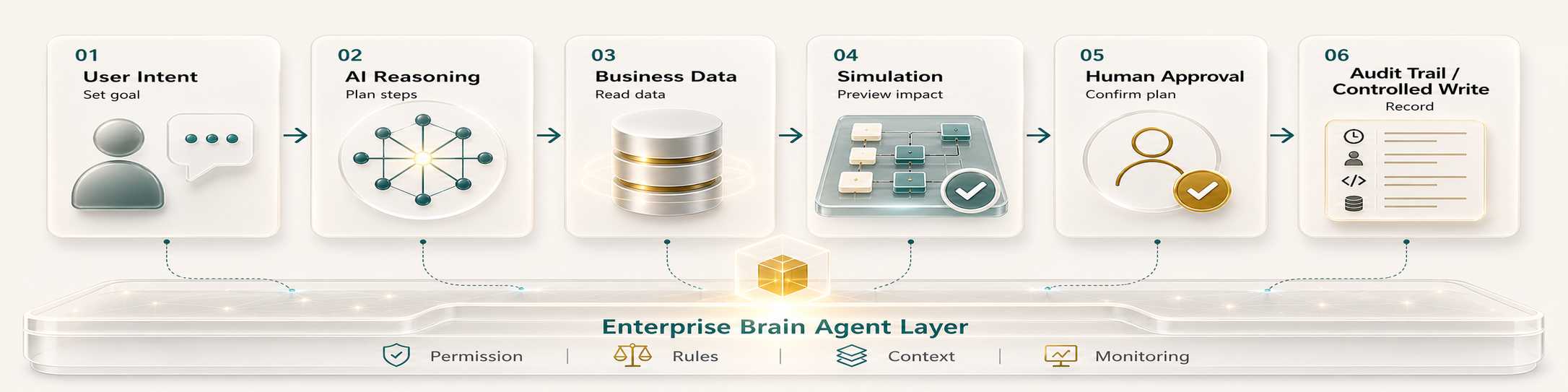
The real risk in automation is not that it gets something wrong — it is that it finishes the whole thing before you notice. So anything that touches money, customers or stock is broken into stages: each one can be stopped and looked at, and each one leaves a record.

Read the full technical view →
Workflow from user intent through impact preview and human confirmation to a controlled write and a clear record
01TriggerA schedule, a system event, a one-line instruction, or a deadline coming up.
02ScanLoad the goal, past decisions and current data before deciding whether to act.
03Preview impactWhich records change, who is affected, how much money moves — before it happens.
04Human confirmHigh-impact writes need a person to nod. Accountability lands on a human.
05ExecuteOnly after confirmation. Low-risk actions run on rules you set, at your threshold.
06Audit trailWho approved, what the system did, how it turned out — recorded and repeatable.
05 — First scenario

Starting with freight
accounts receivable.

We picked this entry point because the pain is clear and easy to quantify: overdue tracking, repeat chasing, duplicate entry, collection cycle, hours spent — every one measurable. Go deep in one vertical, prove the outcome and the reusable procedure, then extend into manufacturing, wholesale and trade.

1One real business line in the pilot
30 daysReviewed at month-end, data returned on request
10Questions you write yourself
A control tower sitting behind everyday business systems, scanning exceptions, assigning owners and tracking progress
06 — Next step

A 30-day pilot,
graded by you.

Pick one real business line and let us bring its data in. At month-end you write ten questions and grade it yourself — if it answers well, we talk about what comes next; if it doesn't, your data goes back untouched. What we want is not “let me think about it”. It is a delivery date for one specific file.